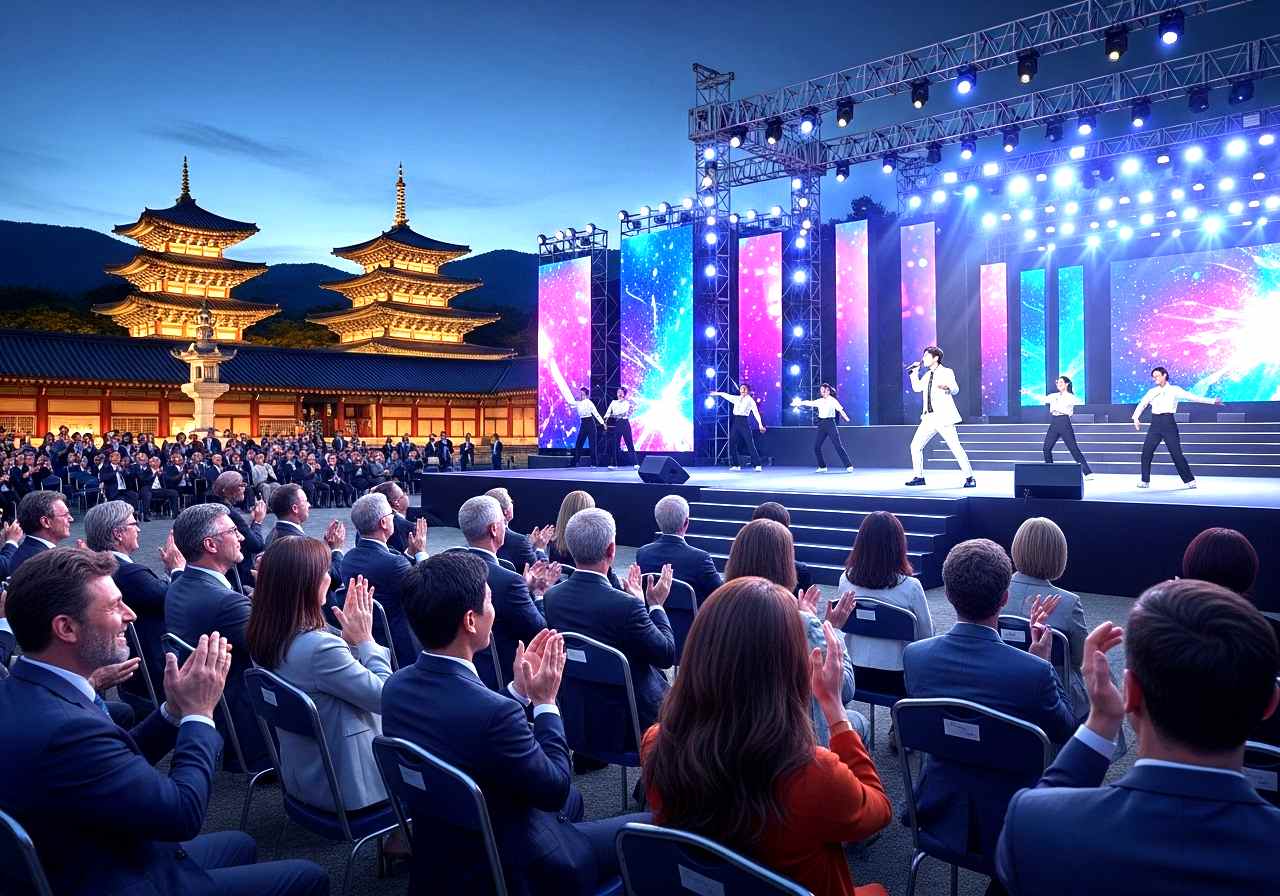
For decades, a nation’s standing on the global stage was quantified by its military might or its Gross Domestic Product (GDP). But South Korea has quietly rewritten the rules of international relations. The successful conclusion of the 2025 Asia-Pacific Economic Cooperation (APEC) Summit, hosted in the historic city of Gyeongju, was the ultimate validation: K-Culture is its most effective diplomatic tool.
The summit, held amidst rising global fragmentation and simmering US-China tensions, required delicate handling. Seoul needed to be a powerful, neutral bridge. It achieved this not through complex political maneuvering alone, but by deploying a force that speaks a universal language: Hallyu (the Korean Wave), seamlessly fused with Korea’s profound historical heritage. The result was a triumph of soft power, shifting global perception and laying the groundwork for concrete diplomatic breakthroughs.
The Strategic Blend: Tradition Meets Trend
Hosting APEC in Gyeongju, the ancient capital of the Silla Kingdom, was itself a powerful statement. It showcased Korea not just as a modern technological powerhouse, but as a nation with deep, compelling historical roots. This duality—the traditional and the trend-setting—was the theme that ran through the entire summit and successfully neutralized the formal stiffness of high-level diplomacy.
At the official APEC Gala Dinner, the performance was a masterclass in cultural synergy. It opened with the traditional sounds of the manpasikjeok (a bamboo flute symbolizing peace) and culminated in modern, high-energy K-Pop showcases. This spectacle included an appearance by K-Pop icon G-Dragon and was emceed by actor/singer Cha Eun-woo . By placing its globally recognized cultural ambassadors on the diplomatic stage, Korea created an instant, viral connection with world leaders and the global press alike.
Moreover, the entire cultural program—from the curated exhibitions at the Gyeongju National Museum to the spectacular media art shows projected onto ancient tombs—communicated a message of competence, sophistication, and a national identity proud of both its past and its future. The cultural experience set a unique, positive tone that made the subsequent difficult trade discussions flow more smoothly.
RM’s Mic Drop: The Power of the Cultural Messenger
Perhaps the most significant symbolic moment was the address delivered by BTS leader RM at the APEC CEO Summit. RM’s speech was not simply an artist’s endorsement; it was a profound diplomatic statement on the nature of global connectivity.
“K-pop’s success came from respecting diversity and embracing world cultures but still holding onto Korea’s unique identity. Just like bibimbap, these parts all keep their unique identities but mix together to make something new and fresh and delightful.”
By comparing K-Pop to bibimbap—the iconic Korean dish symbolizing “harmony in diversity”—RM provided the leaders of 21 economies with a digestible, beautiful metaphor for successful multilateral cooperation. His message urged world leaders to recognize culture as an essential “river” that flows freely and connects humanity, and to invest in creative industries for sustainable global development. The speech effectively framed K-Culture as a model for globalization itself—a harmonious blend of local and international elements.
The Metric of Victory: Culture as a Formal Economic Driver
The ultimate proof of K-Culture’s diplomatic strength lies in a concrete policy outcome. The final Gyeongju Declaration achieved a historic feat by officially embedding the cultural and creative industries as a key area for regional economic cooperation. This wasn’t a mere footnote; it was a deliberate, formal recognition of cultural content—K-Dramas, K-Food, K-Fashion, and K-Beauty—as legitimate economic drivers alongside traditional sectors like trade, technology, and finance.
This diplomatic success is monumental. It legitimizes South Korea’s strategy of leading with its soft power, securing a policy framework that encourages investment and cooperation across the Asia-Pacific region for its creative sectors. It also sets a global precedent for how countries can leverage cultural influence to shape multilateral economic agendas.
K-Food and K-Beauty: The Diplomacy of Daily Life
Beyond the stage performances, the subtle, daily elements of K-Culture served as continuous diplomatic cues. The sophisticated, balanced menu for the leaders’ dinner, featuring local Gyeongju hanwoo (premium Korean beef) and traditional fermented pastes (jang), communicated a national value system of sincerity and balance. Furthermore, as noted at the CEO Summit, the global virality of items like gimbap and the dominance of Korean brands in categories like K-Beauty on global platforms like TikTok underscore an unparalleled level of consumer penetration that translates into geopolitical familiarity and goodwill .
This consumer-level influence creates a foundation of trust and affinity that is invaluable in high-stakes diplomatic environments. When a leader arrives in Seoul or Gyeongju, they are not meeting a distant, abstract state; they are meeting the nation behind the culture they and their constituents already love.
Conclusion: The Blueprint for Modern Global Influence
The APEC 2025 Summit in Gyeongju was a watershed moment that defined the new era of South Korean diplomacy. It confirmed that while political negotiations secure deals, cultural resonance builds the lasting bridges between nations. K-Culture’s ability to create universal emotional connection and its formal recognition as an economic engine in the Gyeongju Declaration prove that soft power is, in fact, the hardest power of all.
South Korea is not just participating in the global conversation; it is setting the tone and writing the script. The world is watching—and listening—to the rhythm of Hallyu.









Leave a Reply